


Accredited investors access private equity deals primarily through private equity funds managed by general partners, direct co-investments, fund-of-funds, and increasingly, specialized online platforms.
These avenues require meeting specific financial criteria, offer varying levels of control and liquidity, and necessitate thorough due diligence to navigate the complex, high-minimum investment landscape outside public markets.
Key Takeaways
- Accreditation is Mandatory: Access to private equity is restricted by regulatory bodies, like the SEC in the U.S., requiring investors to meet specific income or net worth thresholds.
- Diverse Access Points: Investors can engage through traditional private equity funds, co-investments, fund-of-funds, and modern online platforms.
- High Minimums: Private equity investments typically demand substantial capital commitments, often starting at $250,000 to $5 million or more.
- Illiquidity is Standard: Investments are long-term, locking up capital for 5-10 years or more with limited or no redemption options.
- Due Diligence is Critical: Thorough research into the fund manager, investment strategy, and underlying assets is essential to mitigate risk.
- Networking is Key: Building relationships with general partners, wealth managers, and other industry professionals can unlock opportunities.
- Potential for Higher Returns: Private equity offers the potential for outsized returns compared to public markets, compensating for illiquidity and risk.
- Regulatory Framework: The framework for private equity is different from public markets, offering fewer investor protections but also greater flexibility for deal structuring.
What is an Accredited Investor, and Why Does it Matter for Private Equity?
An accredited investor is an individual or entity allowed by financial regulators to invest in certain complex, unregistered securities, including private equity. This designation is crucial because private equity deals are generally not registered with regulatory bodies like the U.S. Securities and Exchange Commission (SEC) due to their high-risk nature and illiquidity, making them unsuitable for the general public.
The primary purpose of the accredited investor definition is investor protection. Regulators assume that individuals meeting these financial thresholds have sufficient knowledge and financial capacity to understand and bear the risks associated with less transparent, high-minimum investments.
Criteria for Accredited Investor Status (U.S. Example)
As of 2026, the primary ways an individual qualifies as an accredited investor in the U.S. include:
- Income: Earned income exceeding $200,000 (or $300,000 with a spouse) in each of the two most recent years, with a reasonable expectation of the same in the current year.
- Net Worth: A net worth over $1 million, either individually or jointly with a spouse, excluding the value of a primary residence.
- Professional Certifications: Holding certain professional certifications, designations, or credentials, such as a Series 7, Series 65, or Series 82 license.
- Knowledgeable Employees: Being a “knowledgeable employee” of a private fund.
Entities such as banks, savings and loan associations, brokers, insurance companies, certain employee benefit plans, and organizations with over $5 million in assets also qualify, subject to specific conditions. Understanding these thresholds is the first step for anyone considering how accredited investors access private equity deals.
How Accredited Investors Access Private Equity Deals: The Primary Avenues
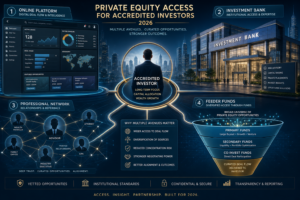
Accredited investors seeking private equity exposure have several distinct routes, each with its own characteristics regarding capital commitment, control, and accessibility. These avenues include traditional private equity funds, direct investments, fund-of-funds, and increasingly, online platforms.
1. Private Equity Funds (Limited Partnerships)
This is the most common method for accredited investors to gain exposure to private equity. Investors commit capital to a fund managed by a general partner (GP), who then deploys that capital across a portfolio of private companies.
- Structure: Typically structured as limited partnerships (LPs), where the accredited investor is a limited partner and the fund manager is the general partner.
- Investment Focus: Funds often specialize by stage (venture capital, growth equity, leveraged buyout), industry (tech, healthcare, real estate), or geography.
- Capital Calls: Investors don’t typically hand over all their committed capital upfront. Instead, the GP makes “capital calls” as investment opportunities arise over several years.
- Minimums: Fund minimums can range from $250,000 to $5 million or more, depending on the fund’s size and reputation.
- Due Diligence Focus: Investors perform due diligence primarily on the GP’s track record, investment strategy, team, and terms (management fees, carried interest).
2. Direct Co-Investments
For highly sophisticated accredited investors, direct co-investments involve investing directly alongside a private equity fund in a specific portfolio company.
- Advantages: This offers greater control, lower fees (as you bypass the fund’s management fee on your co-investment portion), and direct exposure to a specific company.
- Challenges: Requires significant individual due diligence, a strong relationship with a GP willing to offer co-investment opportunities, and a deep understanding of the target company.
- “What if” scenario: Choose direct co-investments if you have substantial capital, deep industry expertise, and a trusted relationship with a lead investor. Otherwise, a fund offers better diversification and professional management.
3. Fund-of-Funds
Fund-of-funds are investment vehicles that invest in multiple underlying private equity funds. This approach offers broad diversification across various GPs, strategies, and vintages.
- Diversification: Provides exposure to a diversified portfolio of private equity funds, reducing manager-specific risk.
- Access: Can offer access to top-tier, often oversubscribed, private equity funds that might otherwise be unavailable to individual accredited investors.
- Layered Fees: Investors pay management fees at both the fund-of-funds level and the underlying fund level, which can dilute returns.
- Ideal for: Accredited investors seeking broad private equity exposure with less direct manager selection burden, willing to accept higher total fees.
4. Online Private Equity Platforms
The rise of financial technology has led to platforms that aggregate private equity opportunities, making them more accessible to accredited investors.
- Increased Access: These platforms democratize access, often lowering the typical minimum investment size compared to direct fund commitments.
- Variety: They list various deals, from venture capital to real estate and private debt, offering curated opportunities.
- Vetting: Platforms typically conduct initial due diligence on listed opportunities, but investors must still perform their own final checks.
- Examples: Platforms like EquityZen, Forge Global, and others facilitate secondary market transactions or direct primary investments.
- Consideration: While these platforms simplify access, it’s vital to research the platform’s reputation, vetting process, and track record.
Comparing Private Equity Access Methods
Each method for how accredited investors access private equity deals comes with distinct trade-offs. The following table provides a concise comparison to help investors weigh their options.
The Critical Role of Due Diligence in Private Equity
Regardless of the access method, rigorous due diligence is paramount for accredited investors accessing private equity deals. Unlike public market investments with readily available information, private equity demands a deeper dive into financial health, management teams, market conditions, and legal structures.
Key Areas of Due Diligence:
- Manager/General Partner (GP) Review:
- Track Record: Examine past performance, not just overall returns, but also consistency, downside protection, and adherence to stated strategy.
- Team Expertise: Assess the experience, stability, and alignment of the GP’s investment team.
- Investment Strategy: Understand how the GP identifies, evaluates, and manages investments. Does it align with your risk appetite and objectives?
- Terms and Conditions: Scrutinize management fees, carried interest, hurdle rates, and key person clauses.
- Investment Strategy & Portfolio:
- Sector Focus: Does the fund concentrate on industries you understand or believe in?
- Geographic Exposure: Evaluate the fund’s geographical focus and associated geopolitical risks.
- Deal Flow: How does the GP source deals? Is there a competitive advantage in deal origination?
- Portfolio Diversification: For a fund, evaluate the proposed number of investments and their potential diversification.
- Financial and Operational Review (for Direct Investments):
- Financial Health: Analyze historical and projected financials, revenue growth, profitability, and cash flow.
- Market Opportunity: Assess the target company’s market position, competitive landscape, and growth potential.
- Management Team: Evaluate the strength and experience of the company’s leadership.
- Exit Strategy: Understand the potential paths for the investment to generate liquidity (e.g., IPO, trade sale).
- Legal and Regulatory Review:
- Offering Documents: Carefully review the Private Placement Memorandum (PPM), Limited Partnership Agreement (LPA), and subscription documents.
- Legal Structure: Understand the legal structure of the investment vehicle and the rights and obligations of limited partners.
- Regulatory Compliance: Ensure the fund and its offerings comply with relevant securities laws.
Common Mistake: A significant error is relying solely on summary documents or a GP’s pitch. Accredited investors must be prepared to conduct independent verification and engage legal and financial advisors. Think of due diligence as uncovering every layer of an onion; the deeper you go, the clearer the picture becomes.
The Role of Advisors and Networking for Accredited Investors
For accredited investors, navigating the private equity landscape effectively often means leveraging professional networks and expert advice. The opaque nature of private markets makes these resources invaluable for identifying opportunities and conducting thorough vetting.
Leveraging Professional Advisors
Financial advisors, wealth managers, and specialized consultants play a crucial role in guiding accredited investors through private equity.
- Wealth Managers: Many wealth managers specialize in working with high-net-worth individuals and have access to private equity offerings through their networks or by structuring feeder funds. They can help integrate private equity into an overall portfolio strategy.
- Investment Consultants: Independent consultants often have deep expertise in alternative investments and can assist with manager selection, due diligence, and portfolio construction.
- Legal Counsel: Given the complex legal structures of private equity deals, engaging experienced legal counsel is essential to review offering documents and ensure investor protection.
- Tax Advisors: Private equity investments can have significant tax implications. A tax advisor can help optimize investment structures and manage tax liabilities.
The Power of Networking
Personal and professional networks are critical for discovering high-quality private equity opportunities. Many top-tier funds are oversubscribed and rely heavily on existing relationships for capital raising.
- Industry Events: Attending private equity conferences and investor summits provides opportunities to meet general partners, co-investors, and other industry participants.
- Peer Networks: Connecting with other accredited investors can lead to shared insights, deal flow, and even co-investment opportunities.
- Family Offices: If you are part of a family office, these entities often have sophisticated investment teams and extensive networks within the private equity world.
- Direct Relationships with GPs: Building direct relationships with general partners can position you for future fund allocations or even direct co-investment opportunities.
- “Networking” can be the most effective way for an accredited investor to find high-quality private equity deals. You can explore how networking works to build these critical relationships.
Understanding the Private Equity Investment Lifecycle
Investing in private equity is a long-term commitment, typically spanning 5 to 10 years, and often longer. Accredited investors must understand this lifecycle, which involves distinct stages from capital commitment to eventual exit.
Stages of a Private Equity Investment:
- Commitment Period (Years 1-5):
- Investors commit a certain amount of capital to the fund.
- The General Partner (GP) identifies and makes new investments.
- “Capital Calls” are made periodically, drawing down committed capital as opportunities are funded. Investors need to ensure they have sufficient liquidity to meet these calls.
- This is an active period of portfolio building.
- Investment Period / Value Creation (Years 3-7):
- The GP actively manages and improves the portfolio companies.
- This involves strategic guidance, operational improvements, and sometimes additional capital injections.
- The goal is to increase the value of the underlying assets.
- Harvesting / Exit Period (Years 5-10+):
- The GP begins to exit investments through various strategies:
- Trade Sale: Selling the company to a larger strategic buyer.
- Initial Public Offering (IPO): Listing the company on a public stock exchange.
- Secondary Buyout: Selling the company to another private equity firm.
- Proceeds from these exits are distributed to the limited partners.
- This stage is crucial for realizing returns, and investment strategies play a large part in the timing.
- The GP begins to exit investments through various strategies:
Patience is a Virtue: Private equity offers limited to no liquidity during this extended period. Investors should only commit capital they do not anticipate needing for other purposes for the foreseeable future. Early redemptions are typically not an option, making this a distinct asset class from publicly traded securities.
Risks and Rewards of Private Equity Investing
Accredited investors are drawn to private equity for its potential for high returns and diversification, but they must also be acutely aware of the significant risks involved. Understanding this balance is fundamental to approaching how accredited investors access private equity deals.
Potential Rewards:
- Higher Potential Returns: Historically, private equity has often outperformed public markets, compensating investors for the illiquidity and complexity. The ability of GPs to actively manage and improve companies contributes to this potential.
- Diversification: Private equity can provide diversification from public market volatility, as its performance is often less correlated with public stock and bond markets.
- Access to Growth: It offers access to fast-growing private companies and innovative sectors before they become available to the broader public, if at all.
- Active Management & Value Creation: GPs actively work with portfolio companies to drive operational improvements, strategic growth, and ultimately, value creation, which can lead to superior returns.
Key Risks:
- Illiquidity: This is arguably the biggest risk. Capital is locked up for many years, with no easy way to redeem or sell your investment.
- High Minimum Investments: The substantial capital commitment can concentrate risk if not properly diversified across multiple funds and strategies.
- Lack of Transparency: Private companies provide less public information compared to public companies, making due diligence more challenging and ongoing monitoring more opaque.
- Manager Risk: The performance of a private equity investment heavily depends on the skill and integrity of the General Partner (GP). A poor GP selection can lead to significant losses.
- Fees: Private equity funds typically charge both a management fee (e.g., 1.5-2.5% of committed capital) and carried interest (e.g., 20% of profits above a hurdle rate), which can significantly impact net returns.
- Capital Call Risk: Investors must be prepared to meet capital calls over time. Failure to do so can result in penalties, including forfeiture of prior investments.
- Regulatory & Market Risk: Changes in regulations or overall economic downturns can impact portfolio companies and exit opportunities.
Decision Rule: Invest in private equity only if you have a long investment horizon, can afford to lose the capital, and understand the fee structure. Do not allocate capital needed for short- or medium-term liquidity.
Conclusion
Accessing private equity deals as an accredited investor in 2026 is a sophisticated undertaking that requires more than just meeting financial thresholds. It demands a clear understanding of the diverse access channels—from traditional funds to direct co-investments and online platforms—and a commitment to rigorous due diligence.
While the promise of potentially higher returns and portfolio diversification is compelling, the significant capital commitments, illiquidity, and complex fee structures necessitate careful consideration and, often, the guidance of experienced financial advisors. For those prepared to navigate its unique landscape, private equity offers a distinct opportunity to invest in the private growth engine of the global economy.
Further Reading
FAQ
What are the main ways accredited investors can get into private equity?
Accredited investors can primarily access private equity through private equity funds, direct co-investments in specific companies, fund-of-funds, and increasingly, specialized online investment platforms.
What is the minimum investment for private equity?
Minimum investment amounts vary significantly but typically range from $25,000 for some online platform deals to $250,000 for smaller funds, and often millions for larger, institutional-grade private equity funds.
Is private equity only for billionaires?
No, private equity is not solely for billionaires. While it requires substantial capital, accredited investor status allows individuals with specific income or net worth thresholds (e.g., $200k income or $1M net worth in the U.S.) to participate.
How long is money typically locked up in a private equity investment?
Money invested in private equity is typically locked up for a long period, often 5 to 10 years or even longer, due to the illiquid nature of private companies and the time required for value creation and exit.
What is a “capital call” in private equity?
A capital call is when a private equity fund manager requests a portion of an investor’s committed capital, often with a few weeks’ notice, to fund a new investment or meet expenses of existing portfolio companies.
Can I sell my private equity investment before the fund exits?
Generally, no. Private equity investments are highly illiquid. While secondary markets exist for selling fund interests, they are niche, opaque, and often involve significant discounts.
What are the main risks for accredited investors in private equity?
Key risks include illiquidity, high minimum investment requirements, lack of transparency, dependence on the fund manager’s skill (manager risk), and substantial fees.
Do I need a financial advisor to invest in private equity?
While not strictly required, engaging a financial advisor, wealth manager, or investment consultant is highly recommended for accredited investors due to the complexity, illiquidity, and significant due diligence required for private equity.
How do private equity funds generate returns?
Private equity funds primarily generate returns through capital appreciation of the underlying companies by improving operations, implementing strategic growth initiatives, and financial restructuring, which culminates in an exit event.
What is the difference between venture capital and private equity?
Venture capital (VC) is a subset of private equity that focuses on investing in early-stage, high-growth companies with significant potential, typically for equity. General private equity often targets more mature companies through leveraged buyouts or growth equity investments.
Discover more from Start Entrepreneur Online
Subscribe to get the latest posts sent to your email.