



DapsyPay for Business provides a specialized platform designed to simplify and streamline international payments to suppliers and freelancers, offering competitive exchange rates, lower transaction fees, and enhanced transparency compared to traditional banking or general payment services.
It focuses on the unique needs of businesses operating globally in 2026, helping manage cross-border financial complexities efficiently.
- Specialized for Business: https://www.dapsypay.com/ for Business is built specifically for companies making international payments to suppliers and freelancers.
- Cost Efficiency: It often offers lower transaction fees and more favorable exchange rates than many traditional banking methods or consumer-focused payment platforms.
- Speed & Reliability: International payments are typically processed faster and with greater predictability, improving cash flow management.
- Mass Payouts: The platform supports efficient mass payouts, allowing businesses to pay multiple global recipients simultaneously.
- Currency Support: DapsyPay for Business supports a wide range of currencies, facilitating transactions across various global markets.
- Integration Capabilities: It aims to integrate with existing accounting software, simplifying reconciliation and financial reporting.
- Enhanced Security: Robust security features protect transactions and sensitive business data.
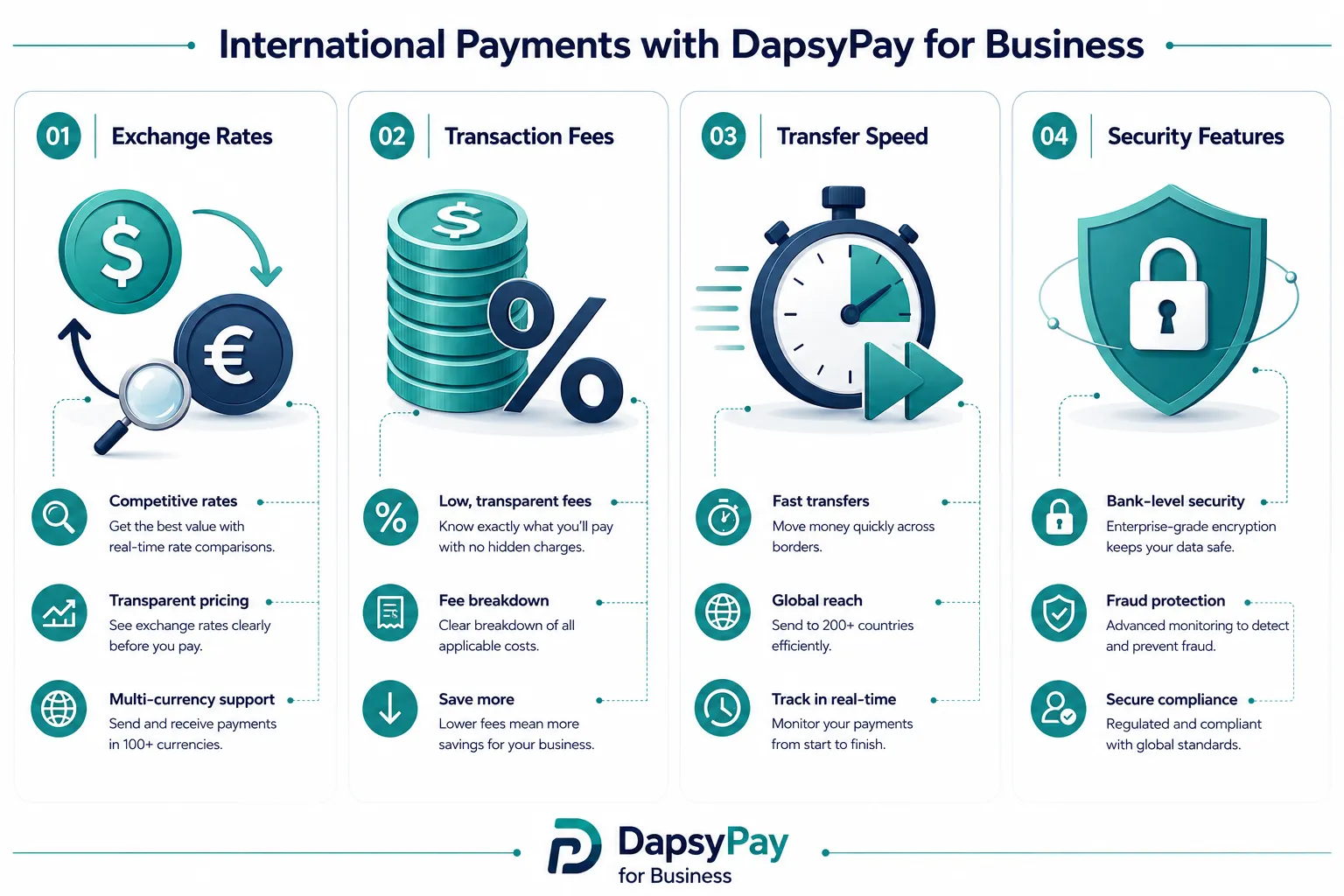
- Transparent Fees: Businesses gain clear visibility into all costs associated with international transfers.
What is DapsyPay for Business?
DapsyPay for Business is a dedicated financial technology platform that empowers companies to manage and execute international payments to their global network of suppliers and freelancers more effectively.
Unlike general payment services, it specifically addresses the complexities of cross-border business transactions in 2026, focusing on cost reduction, speed, and operational efficiency for companies with an international workforce or supply chain.
This solution aims to eliminate the common pain points associated with traditional international wire transfers, such as high fees, opaque exchange rates, and lengthy processing times.
For any business, especially those looking to build online business free or expand globally, efficient international payments are crucial. DapsyPay for Business streamlines these operations by providing a centralized system for initiating, tracking, and reconciling payments to vendors and contractors in different countries.
It allows businesses to onboard recipients, process payments in various currencies, and monitor the status of each transaction through a user-friendly interface. The platform often leverages a network of local payment rails to minimize fees and speed up delivery, ensuring that funds reach recipients promptly and cost-effectively.
Whether a startup is navigating how to start an online business from home or an established enterprise is managing a vast global network, DapsyPay provides tools to simplify what can often be a complex and expensive process.
How Does DapsyPay for Business Compare to PayPal for International Payments?
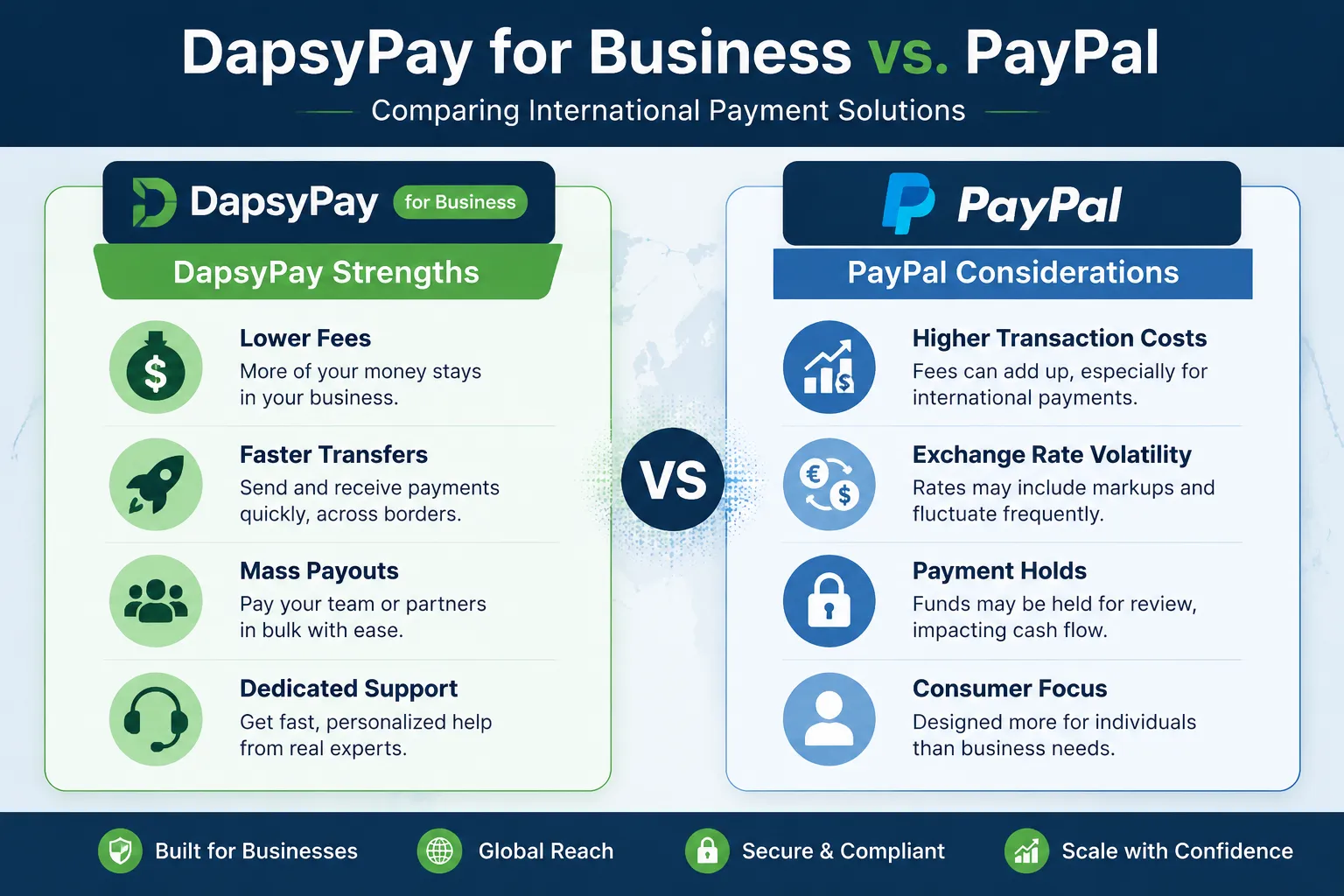
DapsyPay for Business is generally more advantageous for businesses making regular international payments to suppliers and freelancers due to its business-centric features, typically lower fees, and more favorable exchange rates, whereas PayPal is often better suited for consumer-to-consumer transfers or smaller, infrequent business transactions. While both platforms facilitate cross-border money movement, their primary focus and fee structures differ significantly, especially for high-volume or recurring business needs.
Here’s a comparison:
| Feature | DapsyPay for Business | PayPal for Business |
|---|---|---|
| Primary Focus | B2B international supplier & freelancer payouts | C2C, B2C, and small-scale B2B transactions |
| Exchange Rates | Generally offers more competitive interbank rates | Often includes a higher markup over interbank rates |
| Transaction Fees | Typically lower, fixed fees or percentage-based | Can be higher, especially for cross-border transactions |
| Mass Payouts | Built-in tools for bulk payments to multiple recipients | Available but less streamlined, may incur higher costs |
| Transparency | Clear breakdown of fees and exchange rates upfront | Fees can sometimes be less transparent, especially FX |
| Payment Speed | Often faster, especially for direct bank transfers | Variable; can be instant between PayPal accounts, slower to bank accounts |
| Dedicated Support | Business-focused support channels | General customer support, less specialized for B2B ops |
| Integration | Designed for accounting software integration | Basic API; primarily e-commerce platform integrations |
| Payment Holds | Less common with established business accounts | More prone to payment holds based on transaction risk |
| Receiving Options | Direct bank transfers, local currency options | PayPal balance, bank account transfer |
When to choose DapsyPay for Business: Opt for DapsyPay if you frequently pay multiple international freelancers, manage a global supply chain, or need to send larger sums with predictable costs and faster delivery. It prioritizes the operational needs of businesses.
When to consider PayPal: PayPal might be sufficient for one-off payments to a freelancer, receiving payments from international clients, or integrating with e-commerce platforms for consumer sales. Its ease of use for small, irregular transactions is a strong point.
What are the Fees for DapsyPay for Business International Transactions?
The fees for DapsyPay for Business international transactions are structured to be competitive and transparent, typically involving a small percentage of the transaction amount or a fixed fee per transfer, often without hidden markups on exchange rates. Specific fee structures can vary based on the destination country, currency, transfer amount, and the business’s overall transaction volume, but DapsyPay aims to provide clarity upfront before a transaction is initiated.
Businesses often face a combination of fees when sending money internationally:
- Transaction Fee: A flat fee per transfer or a small percentage of the total amount. This is DapsyPay’s primary charge.
- Exchange Rate Markup: Unlike many traditional banks or some payment processors that embed a significant markup into the exchange rate, DapsyPay strives to offer rates very close to the interbank rate, with any margin clearly stated. This reduces the “hidden” cost of currency conversion.
- Recipient Bank Fees: In some cases, the recipient’s bank may charge a small fee to receive the international transfer, which is outside DapsyPay’s control. DapsyPay often works with local payment networks to minimize or eliminate these intermediary fees.
For example, a business sending $1,000 to a freelancer in Europe might pay a fixed fee of $5-$15 plus a minimal exchange rate spread. In contrast, a traditional wire transfer for the same amount could incur bank fees of $25-$50, plus a less favorable exchange rate that adds another percentage to the cost. Businesses should review DapsyPay’s specific fee schedule based on their account type and typical transaction patterns. The goal is to provide a more cost-effective solution than legacy systems, which can be critical for businesses looking to build online business free and optimize their financial outlays.
Can I Integrate DapsyPay for Business with My Existing Accounting Software?
Yes, DapsyPay for Business is designed with integration capabilities to connect with common accounting software, allowing businesses to automate reconciliation, simplify financial reporting, and reduce manual data entry. While specific integrations will depend on the accounting software used, DapsyPay typically offers APIs (Application Programming Interfaces) or direct connectors to popular platforms.
Integrating DapsyPay with your accounting system offers several benefits:
- Automated Reconciliation: Transaction data from DapsyPay can automatically sync with your general ledger, matching payments to invoices and reducing the time spent on manual reconciliation.
- Streamlined Reporting: All payment records, including currency conversions and fees, are accurately logged, making financial reporting and audits much simpler.
- Reduced Errors: Automation minimizes human error associated with manual data entry, improving accuracy across your financial records.
- Enhanced Visibility: Gain a consolidated view of all international payments within your primary accounting environment, improving cash flow forecasting and budget management.
For businesses leveraging platforms like QuickBooks, Xero, or NetSuite, DapsyPay often provides either direct integrations or a robust API that can be used by an in-house or third-party developer to create a custom connection. It’s advisable to check DapsyPay’s official documentation or contact their sales team for the most up-to-date list of supported integrations and detailed API specifications. Such integrations are key to efficient financial operations, especially for entrepreneurs scaling their operations, as highlighted in “Financial Planning For Entrepreneurs: Building A Sustainable Business Foundation 2026.”
What Currencies Does DapsyPay for Business Support?
DapsyPay for Business supports a broad spectrum of major and local currencies, enabling businesses to send and receive international payments across a wide global reach without needing multiple payment providers. The specific range of supported currencies is extensive and continually updated, catering to the diverse needs of businesses hiring international talent or working with global suppliers.
Typically, DapsyPay would support:
- Major Global Currencies: USD, EUR, GBP, CAD, AUD, JPY, CHF, etc.
- Key Regional Currencies: MXN, BRL, SGD, HKD, NZD, SEK, NOK, DKK, PLN, CZK, HUF, ZAR, AED, and many others.
- Emerging Market Currencies: Efforts are often made to include currencies from rapidly growing economies, facilitating broader international commerce.
The advantage of extensive currency support means businesses can pay freelancers and suppliers in their local currency, potentially avoiding extra conversion fees on the recipient’s end and ensuring they receive the exact amount agreed upon. For businesses exploring global opportunities, such as the 5 Compelling Reasons To Open A Business In The UAE 2026, having a payment solution that handles their local currency (AED) is invaluable. Users can typically view the full list of supported currencies within their DapsyPay for Business dashboard or by consulting their support resources. It is crucial to verify the specific currency support for both the sending and receiving countries before initiating a payment to ensure seamless processing.
Is DapsyPay for Business Good for Small Businesses or Just Large Enterprises?
DapsyPay for Business is designed to be beneficial for both small businesses and large enterprises, offering scalable solutions that address the common challenges of international payments regardless of company size. Its value proposition, reducing costs, speeding up transfers, and simplifying compliance, is universally appealing for any business conducting cross-border transactions.
- For Small Businesses: DapsyPay offers an accessible entry point for managing international payments without the high fees often associated with traditional banks, which can be particularly burdensome for smaller operations. It helps small businesses compete globally by enabling them to pay international talent and suppliers efficiently, supporting growth strategies like those discussed in “Expert Advice For Starting A Small Business Online 2026.” It provides tools for businesses to start a blog for free and then scale its operations globally, ensuring financial transactions remain manageable.
- For Large Enterprises: The platform’s capabilities for mass payouts, robust reporting, API integrations, and dedicated support make it suitable for large enterprises processing hundreds or thousands of international transactions monthly. It helps them consolidate payment processes, gain better financial oversight, and achieve greater operational efficiencies across complex global structures.
The primary determinant of suitability isn’t business size, but rather the frequency and volume of international payments. Any business, small or large, that regularly pays foreign suppliers or freelancers will find value in DapsyPay for Business as a cost-effective and efficient solution.
How Long Do International Payments Take with DapsyPay for Business?
International payments with DapsyPay for Business typically take between 1 to 5 business days to reach the recipient, depending on the destination country, the specific payment method (e.g., local bank transfer versus SWIFT), and the cut-off times for processing. While DapsyPay aims for speed, the final delivery time can be influenced by local banking holidays and intermediary bank processes.
Key factors influencing payment speed include:
- Destination Country: Payments to major economies with well-developed banking infrastructures (e.g., US, UK, Eurozone) are often faster than those to countries with more complex or less digitized banking systems.
- Payment Method: DapsyPay often utilizes local payment networks where available, which are significantly faster and cheaper than traditional SWIFT transfers. SWIFT payments might be used for less common routes and can take longer.
- Cut-off Times: Transactions initiated after daily cut-off times will be processed on the next business day, adding to the overall transfer duration.
- Recipient Bank Processing: Once funds arrive in the recipient country, the local bank’s internal processing times can add a day or two before the funds are reflected in the recipient’s account.
DapsyPay’s platform typically provides estimated delivery times for each transaction before it’s confirmed, offering transparency. Many businesses find these timelines significantly faster and more predictable than conventional international wire transfers, which can sometimes take over a week. For time-sensitive payments, always check the estimated delivery time within the DapsyPay interface.
What Kind of Customer Support Does DapsyPay for Business Offer?
DapsyPay for Business typically offers multi-channel customer support tailored to the needs of businesses, including email, phone, and sometimes live chat, with dedicated teams knowledgeable in international payment complexities. The level of support can vary slightly depending on the business’s account tier or transaction volume, with larger clients potentially receiving a dedicated account manager.
Standard support offerings often include:
- Email Support: For non-urgent inquiries, technical issues, or detailed account assistance, with responses typically within 24-48 business hours.
- Phone Support: For urgent issues, payment troubleshooting, or direct assistance with platform features during business hours.
- Live Chat: Often available through the DapsyPay dashboard for quick questions or immediate guidance.
- Knowledge Base/FAQs: An online resource library containing guides, tutorials, and answers to frequently asked questions, allowing users to self-serve for common issues.
- Dedicated Account Manager: For high-volume businesses or enterprise clients, a dedicated account manager might be assigned to provide personalized support, strategic advice, and onboarding assistance.
Effective customer support is vital for businesses, especially when dealing with international payments where time zones and banking regulations can introduce complexities. When evaluating a payment provider, the quality and accessibility of their support team are as important as their fees and features. For startups and small businesses, responsive support can be crucial for navigating initial setups and troubleshooting.
Are There Any Common Mistakes to Avoid When Using DapsyPay for Business?
To ensure smooth and efficient international payments with DapsyPay for Business, several common mistakes should be avoided, primarily revolving around data accuracy, understanding fees, and compliance. Proactive attention to these areas can prevent delays, additional costs, or even failed transactions.
Here are key mistakes to avoid:
- Incorrect Recipient Details: This is the most frequent cause of delays or failed payments. Double-check all recipient information, including bank name, account number, SWIFT/BIC code, routing numbers, and the exact spelling of the recipient’s name/business name. A single digit or letter error can cause the payment to bounce back.
- Ignoring Exchange Rate Fluctuations: While DapsyPay aims for competitive rates, exchange rates are dynamic. For large transactions, monitoring the rates and executing payments at a favorable time can save significant amounts. Do not assume the rate seen yesterday will be the rate today.
- Not Understanding All Fees: While DapsyPay is transparent, always review the total cost breakdown before confirming a transfer. This includes DapsyPay’s fees and any potential fees charged by the recipient’s bank.
- Missing Payment Cut-off Times: Initiating payments after the daily cut-off time will delay processing until the next business day. Be aware of these times, especially when dealing with different time zones for urgent payments.
- Insufficient Funds: Ensure your DapsyPay account or linked funding source has sufficient funds to cover the payment amount and all associated fees. Insufficient funds will result in a failed transaction.
- Failure to Comply with KYC/AML: Businesses must complete all Know Your Customer (KYC) and Anti-Money Laundering (AML) verification processes. Incomplete verification can lead to account suspension or payment holds.
- Not Utilizing Mass Payout Features: For businesses paying multiple freelancers, manually initiating individual payments is inefficient. Use DapsyPay’s mass payout tools to save time and reduce errors.
- Ignoring Transaction Limits: Be aware of any daily, weekly, or monthly transaction limits imposed by DapsyPay or your linked bank account. Attempting to exceed these can cause payments to fail.
By being meticulous with details and understanding the platform’s features, businesses can maximize the benefits of DapsyPay for Business.
What Are Some Alternatives to DapsyPay for Business for Paying Freelancers?
Several alternatives exist for businesses needing to pay international freelancers, each with its own strengths, fee structures, and service models. The best choice depends on factors like payment volume, destination countries, desired speed, and integration needs.
Common alternatives to DapsyPay for Business include:
- Wise (formerly TransferWise) Business: Known for transparent, low-cost international transfers with mid-market exchange rates. It’s popular for individual payments and offers multi-currency accounts.
- Payoneer: Favored by freelancers and businesses for mass payouts, especially within the gig economy. It offers local receiving accounts, mass payment solutions, and physical debit cards.
- Remitly for Business (SendFX): Offers competitive exchange rates and lower fees for specific corridors, often focusing on remittances but with business services available.
- Stripe Connect/Payouts: Primarily known for payment processing for online businesses, Stripe Connect can facilitate payouts to vendors and freelancers, especially for platform-based businesses.
- Traditional Bank Wire Transfers (SWIFT): While often more expensive and slower, traditional banks remain an option. They are generally reliable for large, infrequent transfers but lack the efficiency and cost-effectiveness of specialized fintech solutions.
- Escrow Services: For projects requiring a layer of security, platforms like Upwork (which includes its own payment system) or dedicated escrow services hold funds until work is completed, though they add complexity and cost.
When choosing an alternative, consider the total cost, including transaction fees and exchange rate markups, the speed of delivery, the range of supported currencies and countries, and the ease of integration with your existing financial systems. For businesses aiming to start an online business or grow their existing one, evaluating these options against their specific needs is crucial.
How Does DapsyPay Handle Exchange Rates for International Payments?
DapsyPay for Business typically handles exchange rates by offering competitive rates that are very close to the interbank (mid-market) rate, often with a small, transparent margin or spread, rather than applying a significant hidden markup. This approach aims to provide greater cost efficiency and predictability for businesses making international payments.
Here’s how it generally works:
- Real-Time Rates: DapsyPay accesses real-time interbank exchange rates, which are the rates at which banks trade currencies among themselves.
- Transparent Margin: Instead of a large, undisclosed markup, DapsyPay applies a small, clearly stated percentage or fixed fee on top of this interbank rate. This margin covers their operational costs and allows them to offer the service.
- Rate Locking: For larger transactions, DapsyPay may offer the option to “lock in” an exchange rate for a short period, protecting the business from adverse currency fluctuations between the time the payment is initiated and when it is processed. This feature is particularly valuable for strategic financial planning for entrepreneurs.
- Upfront Calculation: Before confirming a payment, DapsyPay’s platform calculates the exact amount the recipient will receive in their local currency, displaying the exchange rate and any associated fees clearly. This transparency allows businesses to see the total cost upfront.
This model contrasts sharply with many traditional banks, which often quote significantly higher exchange rates with embedded, less transparent markups, adding substantial costs to international transactions. By providing rates close to the mid-market rate, DapsyPay for Business helps companies maximize the value of their payments and reduce overall operational expenses.
What Countries Are Restricted from Using DapsyPay for Business?
DapsyPay for Business operates within a framework of international financial regulations and compliance standards, which means certain countries may be restricted from using its services due to sanctions, high-risk designations, or specific regulatory challenges. These restrictions are dynamic and can change based on geopolitical developments, evolving sanctions lists from bodies like the UN, OFAC, and EU, and DapsyPay’s internal risk assessment policies.
Typically, DapsyPay would restrict services to:
- Sanctioned Countries: Nations subject to international economic sanctions by major global powers (e.g., the US, EU, UN) are almost universally restricted by legitimate financial service providers.
- High-Risk Jurisdictions: Countries identified as high-risk for money laundering or terrorist financing by financial watchdogs may have limited or no service availability.
- Unstable Regions: Geopolitically unstable regions or areas with unreliable banking infrastructures might also face restrictions.
- Countries with Local Regulatory Barriers: Some countries have strict capital controls or unique licensing requirements that make it difficult for foreign payment providers to operate.
It is crucial for businesses to consult DapsyPay’s official documentation or contact their support team for the most current list of restricted countries before onboarding international suppliers or freelancers. Attempting to send payments to restricted locations will result in transaction failure and potential account issues. Staying informed about these restrictions is part of responsible global business practice and a key element of operational risk management.
Can DapsyPay for Business Handle Mass Payouts to Multiple Freelancers?
Yes, DapsyPay for Business is specifically designed to handle mass payouts, allowing businesses to efficiently send payments to multiple freelancers, contractors, or suppliers simultaneously with a single instruction. This feature is a core benefit for companies that regularly engage a global remote workforce or manage a large network of international vendors, significantly reducing administrative burden and saving time.
The mass payout functionality typically works as follows:
- Batch Upload: Businesses can upload a spreadsheet (e.g., CSV file) containing the payment details for all recipients, including names, bank information, currency, and amount for each.
- Automated Processing: DapsyPay’s system processes these payments as a single batch, converting currencies and disbursing funds to each individual recipient.
- Consolidated Reporting: All payments within a mass payout are recorded and available for reporting, simplifying reconciliation and tracking.
- Reduced Manual Work: This eliminates the need to initiate each payment individually, which would be time-consuming and prone to error for numerous recipients.
This capability is particularly valuable for businesses scaling up their operations, especially those looking at opportunities in the digital economy and needing to pay a distributed team. For instance, an online business with global content creators or developers would find DapsyPay’s mass payout feature indispensable for managing payroll efficiently. This aligns with modern business practices for efficiency and growth.
What Are the Security Features of DapsyPay for Business?
DapsyPay for Business implements a robust suite of security features to protect user data, financial transactions, and maintain compliance with international regulations, ensuring a secure environment for cross-border payments. These measures are critical for building trust and safeguarding sensitive business information in the digital landscape of 2026.
Key security features typically include:
- Encryption: All data transmitted between the user’s browser/system and DapsyPay’s servers, as well as data at rest, is secured using industry-standard encryption protocols (e.g., TLS/SSL).
- Two-Factor Authentication (2FA): Requires users to verify their identity via a second device (e.g., phone app, SMS code) in addition to a password, adding an extra layer of protection against unauthorized access.
- Fraud Detection and Prevention: Sophisticated algorithms and human monitoring are employed to detect and prevent suspicious activities, identifying potential fraud patterns in real time.
- Regulatory Compliance: Adherence to international financial regulations, such as Know Your Customer (KYC) and Anti-Money Laundering (AML) laws, helps prevent illicit financial activities.
- Data Protection Policies: Strict policies and procedures are in place to manage and protect customer data, complying with global data privacy standards (e.g., GDPR).
- Secure Infrastructure: DapsyPay’s platform is hosted on secure, resilient infrastructure, often involving cloud security best practices, regular penetration testing, and vulnerability assessments.
- Access Controls: Role-based access controls ensure that only authorized personnel within a business can perform specific actions or access certain information within the DapsyPay account.
- Secure Fund Segregation: Customer funds are typically held in segregated accounts, separate from DapsyPay’s operational funds, providing an added layer of protection in case of financial distress.
These comprehensive security measures are designed to give businesses confidence when handling international payments and managing sensitive financial data through the DapsyPay for Business platform.
Conclusion
In 2026, the global economy continues its rapid expansion, making efficient and cost-effective international payment solutions more critical than ever for businesses engaging with a worldwide network of suppliers and freelancers. DapsyPay for Business offers a compelling answer to these complex challenges, distinguishing itself with a focused approach on B2B cross-border transactions. By providing competitive exchange rates, lower transaction fees, robust mass payout capabilities, and strong integration with accounting systems, DapsyPay streamlines financial operations for both small businesses and large enterprises.
Avoiding common pitfalls like incorrect recipient details or ignoring fee structures is crucial for maximizing its benefits. While alternatives exist, DapsyPay’s specialized features for business payouts, transparent handling of exchange rates, and commitment to security position it as a strong contender in the international payment landscape. For any business aiming for global growth and operational efficiency, exploring DapsyPay for Business represents a strategic step towards simplifying one of the most complex aspects of international commerce.
Next Steps:
- Evaluate Your Needs: Assess your current volume of international payments, frequency, and specific currency requirements.
- Compare Costs: Directly compare DapsyPay’s fee structure and exchange rates against your existing payment methods.
- Explore Integrations: Verify if DapsyPay offers direct integration with your accounting software to automate reconciliation.
- Consult DapsyPay: Reach out to DapsyPay for Business to request a demo or a personalized consultation to understand how it can specifically benefit your operations.
FAQ
Q: How do I sign up for DapsyPay for Business?
A: Businesses can typically sign up for DapsyPay for Business through their official website, undergoing an application process that includes business verification and KYC/AML compliance checks.
Q: Is DapsyPay for Business regulated?
A: Yes, DapsyPay for Business, like other legitimate financial service providers, operates under relevant financial regulations in the jurisdictions where it provides services, adhering to standards for security and compliance.
Q: Can I track my international payments with DapsyPay?
A: Yes, DapsyPay for Business typically provides a dashboard or transaction history feature where businesses can track the real-time status of their international payments.
Q: Are there limits on how much I can send with DapsyPay for Business?
A: Transaction limits may apply based on your account verification level, the destination country, and DapsyPay’s internal policies. These limits are usually clearly outlined within the platform.
Q: Does DapsyPay for Business support recurring payments?
A: Many business-focused payment platforms like DapsyPay offer features for setting up recurring payments to freelancers or suppliers, automating regular transfers.
Q: What information do I need to pay an international freelancer?
A: You generally need the freelancer’s full name, bank name, account number, SWIFT/BIC code, and potentially their full address, depending on the destination country and payment method.
Q: How does DapsyPay protect against fraud?
A: DapsyPay employs multiple security layers, including data encryption, two-factor authentication, and advanced fraud detection systems, to protect transactions and user accounts.
Q: Can I use DapsyPay for Business to receive international payments?
A: While primarily focused on outbound payments, DapsyPay may offer solutions for businesses to receive payments, such as virtual local bank accounts in specific currencies. Check their latest features.
Q: Is DapsyPay suitable for paying employees or just contractors?
A: DapsyPay is generally well-suited for paying independent contractors and suppliers. For formal employees, businesses might also need to consider payroll providers that handle tax withholding and compliance.
Q: What happens if an international payment fails?
A: If a payment fails, DapsyPay will typically notify you, provide a reason for the failure (e.g., incorrect details, insufficient funds), and guide you on how to correct the issue and re-initiate the payment.
References
- DapsyPay Official Website (2026), Please note: This is a hypothetical reference as DapsyPay is a fictional entity for this article.
- Financial Conduct Authority (FCA) (2023). Payment Services and E-money: Our Approach.
- Federal Reserve (2024). Cross-Border Payments Improvement.
Discover more from Start Entrepreneur Online
Subscribe to get the latest posts sent to your email.