


Digital banking offers global businesses and startups unparalleled agility and reach by providing multi-currency accounts, real-time international payments, integrated financial tools, and streamlined compliance, all accessible through online and mobile platforms at https://arival.com/ . This shift from traditional banking enables faster operations, reduced costs, and enhanced financial oversight crucial for navigating international markets efficiently.
- Digital banking provides global businesses and startups with tools to manage finances across borders seamlessly.
- Multi-currency accounts and swift international payment capabilities are core benefits, reducing FX fees and delays.
- Cloud-based platforms offer real-time financial visibility and robust analytics, aiding strategic decision-making.
- Enhanced security features, including advanced encryption and multi-factor authentication, protect sensitive financial data.
- APIs and integrations with other business software streamline accounting, payroll, and expense management.
- Digital banks often provide more competitive fees and transparent pricing structures compared to traditional institutions.
- Compliance with diverse international regulations is simplified through automated reporting and robust KYC/AML processes.
- Choosing the right digital banking partner requires evaluating features like global reach, currency support, and integration capabilities.
- Startups can benefit from lower overheads and faster onboarding processes offered by digital banking solutions.
- The landscape of Digital Banking for Global Businesses & Startups is continuously evolving, with AI and automation playing increasingly vital roles.
What is Digital Banking for Global Businesses & Startups?
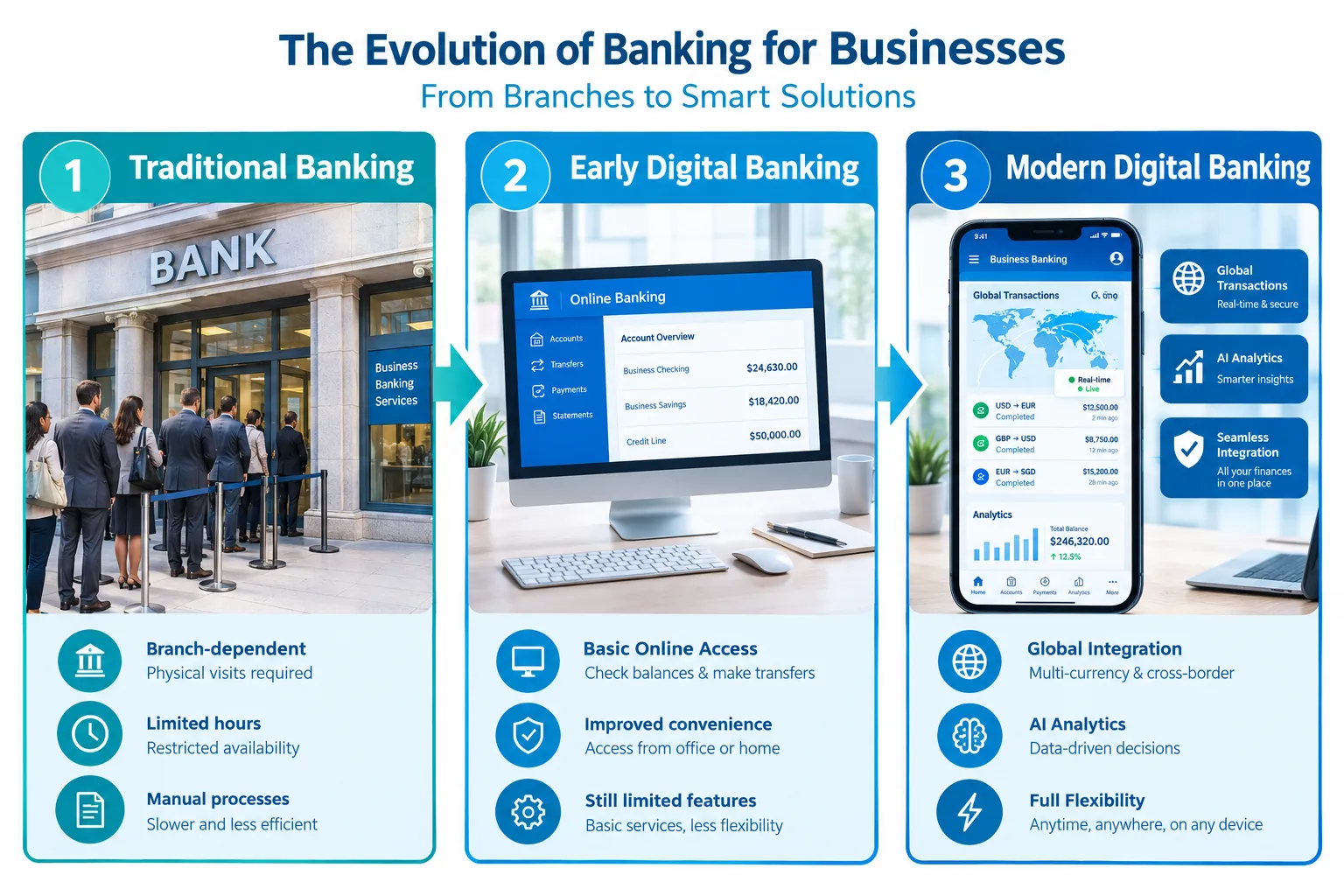
Digital banking for global businesses and startups refers to a suite of financial services delivered entirely through online and mobile channels, designed to support operations that span multiple countries and currencies. Unlike traditional banking, which relies heavily on physical branches and legacy systems, digital banking leverages technology to provide instant access, automate processes, and offer sophisticated financial management tools tailored for the complexities of international trade and rapid growth. This empowers companies to manage their finances, make payments, and handle foreign exchange efficiently from anywhere in the world.
For companies operating internationally or those planning to expand, digital banking is not just an alternative but a strategic necessity in 2026. It addresses common pain points like slow international transfers, high foreign exchange fees, limited visibility into global cash flow, and complex compliance requirements. Digital banks, often called neobanks or challenger banks, operate without a physical branch network, passing on cost savings to their customers through lower fees and better exchange rates. They typically offer services such as multi-currency accounts, international payment rails, virtual cards, integrated expense management, and API access for seamless connection with other business tools.
Key Characteristics of Digital Banking for Global Businesses:
- Online-First Model: All services are accessible via web portals and mobile applications, eliminating the need for physical branch visits.
- Multi-Currency Accounts: Businesses can hold, send, and receive funds in numerous foreign currencies, often with competitive exchange rates. This feature is particularly valuable for businesses dealing with international suppliers or customers, as it minimizes conversion fees and simplifies reconciliation.
- Real-time Transactions: International payments and transfers are processed significantly faster than traditional methods, often in minutes or hours rather than days. This speed is critical for maintaining supply chain liquidity and meeting payment deadlines across time zones.
- Integrated Financial Management: Digital platforms often include tools for expense tracking, budgeting, invoicing, and payroll, providing a holistic view of a company’s financial health. Some platforms offer advanced analytics dashboards, allowing businesses to monitor cash flow, predict trends, and make informed decisions quickly.
- API Connectivity: Many digital banks offer Application Programming Interfaces (APIs) that allow businesses to integrate their banking services directly with their accounting software, ERP systems, and other operational tools. This automation reduces manual data entry, minimizes errors, and creates a more cohesive financial ecosystem. For example, a global e-commerce startup using a platform like Shopify could integrate its digital bank account to automatically reconcile sales in various currencies.
- Enhanced Security: Digital banks employ advanced security measures such as end-to-end encryption, multi-factor authentication (MFA), biometric login, and AI-driven fraud detection to protect customer funds and data. They often leverage cloud-based infrastructure, which is regularly updated with the latest security protocols.
- Customer Support: While lacking physical branches, digital banks provide 24/7 customer support through various channels, including chat, email, and phone, often with dedicated account managers for business clients.
Why is Digital Banking Essential for Global Startups and Businesses in 2026?
Digital banking is essential for global startups and businesses in 2026 because it provides the agility, cost-efficiency, and global reach necessary to thrive in an increasingly interconnected and fast-paced economic environment. For new ventures and established companies alike, traditional banking systems often present significant hurdles in international operations, such as high fees, slow transaction times, and cumbersome regulatory processes. Digital banking solutions directly address these challenges, allowing businesses to operate globally with the same ease as they might domestically.
Consider a startup selling products through a Print On Demand Business model, sourcing materials from Asia, manufacturing in Europe, and selling to customers worldwide. Without efficient international banking, managing payments to suppliers, receiving payments from customers in various currencies, and tracking expenses across multiple jurisdictions would be a complex and costly nightmare. Digital banking streamlines these operations, offering tools for automated currency conversion, lower international transfer fees, and clear visibility into all transactions, thus freeing up valuable time and resources for growth.
Key Reasons for Essentiality:
- Global Reach and Accessibility: Digital banking removes geographical barriers, allowing businesses to open accounts, conduct transactions, and manage finances from anywhere in the world. This is particularly beneficial for remote teams or companies without a physical presence in every market they operate in. A startup founder can manage their entire global financial operations from their laptop, whether they are in London or Bali.
- Cost Efficiency: Digital banks typically have lower operating costs due to their lack of physical branches, and these savings are often passed on to customers. Businesses benefit from reduced foreign exchange fees, lower international transfer charges, and often no monthly maintenance fees. These savings can be significant, especially for startups and small businesses where every dollar counts. Traditional banks may charge 3-5% on currency conversions, whereas digital alternatives might offer near interbank rates with a small, transparent fee.
- Speed and Efficiency of Transactions: Cross-border payments, which can take several days with traditional banks, are often completed in hours or even minutes with digital banking platforms. This rapid transaction speed improves cash flow management, allows for quicker settlement with suppliers, and enhances customer satisfaction for international sales.
- Streamlined Financial Management: Digital banking platforms provide comprehensive dashboards that offer a real-time, consolidated view of all accounts, transactions, and financial data. Features like automated categorization of expenses, customizable reporting, and instant notifications help businesses maintain tighter control over their finances. This level of detail is crucial for effective how to run a business operations and strategic planning.
- Simplified Compliance: Navigating the diverse regulatory landscapes of international finance can be daunting. Digital banks often build robust Know Your Customer (KYC) and Anti-Money Laundering (AML) processes into their digital platforms, streamlining compliance checks and reducing the administrative burden on businesses. Many also offer tools to generate reports that adhere to various national accounting standards.
- Scalability: As startups grow and expand into new markets, digital banking solutions can easily scale to meet increased transaction volumes, additional currency needs, and new regulatory requirements without requiring a complete overhaul of their financial infrastructure. This scalability is a significant advantage over rigid traditional banking systems.
- Integration with Business Ecosystems: The open API architecture of many digital banks allows for seamless integration with a wide range of business tools, including accounting software (e.g., Xero, QuickBooks), e-commerce platforms (e.g., Shopify, Magento), payroll systems, and expense management solutions. This creates a unified financial ecosystem that enhances automation and data flow.
- Access to Innovative Features: Digital banking continually introduces new technologies and features, such as AI-powered financial insights, virtual corporate cards with spending limits, subscription management tools, and enhanced budgeting functionalities. These innovations provide businesses with a competitive edge and better control over their finances.
How Do Global Businesses & Startups Select the Right Digital Banking Partner?
Selecting the right digital banking partner involves a thorough evaluation of a provider’s global reach, supported currencies, fee structure, integration capabilities, and security features to ensure it aligns with the specific operational needs and growth trajectory of the business. The ideal partner will offer a blend of technological sophistication, cost-effectiveness, and regulatory compliance that empowers seamless international financial management.
For instance, a startup focused on e-commerce might prioritize easy integration with payment gateways and multi-currency payment processing, while a consulting firm with employees across different continents might need robust payroll features and virtual cards. It’s crucial to look beyond basic services and assess how the digital bank can truly act as an enabler for global expansion and efficiency in 2026.
Key Considerations When Choosing a Digital Banking Partner:
- Global Reach and Currency Support:
- Question: Does the bank support the countries where your business operates or plans to expand?
- Criteria: Look for a provider that offers accounts in the primary currencies you use (e.g., USD, EUR, GBP, JPY, CNY) and supports transfers to and from your key markets. Some platforms offer local account details in various countries, which can simplify receiving payments and reduce fees for your international customers.
- Decision Rule: Choose a bank with extensive currency support if your business has diverse international transactions; opt for one with strong coverage in your core markets if operations are more concentrated.
- Fee Structure and Exchange Rates:
- Question: Are the fees transparent and competitive, especially for international transactions and currency conversions?
- Criteria: Compare monthly maintenance fees, international wire transfer fees, ATM fees, and foreign exchange rates. Digital banks often pride themselves on transparency and lower costs, but these can vary significantly. Some banks offer near interbank exchange rates with a small, flat fee, while others might include a percentage markup.
- Common Mistake: Only looking at advertised “no fee” accounts without investigating hidden charges for specific services, especially international transfers.
- Integration Capabilities (APIs):
- Question: Can the digital bank integrate with your existing accounting, payroll, and e-commerce software?
- Criteria: Robust API capabilities are vital for automating financial workflows. Ensure the bank offers integrations with popular business tools (e.g., QuickBooks, Xero, Stripe, Shopify, or even specialized platforms like those for Square For Small Business). This reduces manual data entry, minimizes errors, and provides a unified view of your finances.
- Example: A startup using Xero for accounting would want a digital bank that can automatically sync transaction data, saving hours in reconciliation.
- Security and Compliance:
- Question: What security measures are in place, and how does the bank handle regulatory compliance in different jurisdictions?
- Criteria: Look for banks that employ advanced encryption, multi-factor authentication, biometric logins, and robust fraud detection systems. Verify their licensing and adherence to financial regulations (e.g., FDIC protection in the US, FSCS in the UK). For global operations, understanding how they manage KYC (Know Your Customer) and AML (Anti-Money Laundering) requirements across borders is critical.
- Edge Case: If you operate in highly regulated industries or jurisdictions, ensure the digital bank has specific experience and features to support those unique compliance needs.
- Features and Functionality:
- Question: Does the bank offer the specific features your business needs for efficient global operations?
- Criteria: This can include virtual cards for employees, integrated expense management, automated invoicing, bulk payment processing, dedicated account managers, and advanced reporting tools. Consider whether they offer budgeting features, cash flow forecasting, or even business credit lines.
- Quick Example: A marketing agency with contractors worldwide might need virtual cards with customizable spending limits and easy expense reconciliation features.
- Customer Support:
- Question: How accessible and effective is their customer support, especially for international issues?
- Criteria: Evaluate the availability of support channels (24/7 chat, email, phone), response times, and the quality of assistance. For global businesses, it’s beneficial if they offer support in multiple languages or have specialized teams for different regions.
- Reputation and Reviews:
- Question: What do other global businesses and startups say about their experience with the bank?
- Criteria: Check independent reviews, forums, and testimonials. Look for feedback on reliability, ease of use, problem resolution, and overall satisfaction, especially concerning cross-border transactions.
By carefully weighing these factors, businesses can identify a digital banking partner that not only meets their current needs but also supports their future international growth and operational efficiency.
Key Features and Benefits of Digital Banking for Global Businesses & Startups
Digital banking offers a powerful suite of features and benefits that significantly enhance financial operations for global businesses and startups, providing capabilities often lacking in traditional banking models. These advantages include superior financial visibility, accelerated global transactions, reduced operational costs, and simplified compliance, all of which are critical for scaling an international presence in 2026.
For a startup navigating the complexities of international trade, these features translate directly into competitive advantages. For example, a software-as-a-service (SaaS) company selling subscriptions globally needs to accept payments in various currencies, manage international payroll for remote employees, and track expenses across different regions. Digital banking solutions provide the infrastructure to handle these operations efficiently and affordably, allowing the company to focus on product development and market expansion rather than administrative burdens.
Features and Their Corresponding Benefits:
- Multi-Currency Accounts and Local Banking Details:
- Feature: Ability to hold, send, and receive funds in numerous major and minor currencies, often with local account details (e.g., a local EUR IBAN, a local USD account number).
- Benefit: Reduces foreign exchange conversion fees and allows businesses to invoice and pay in local currencies, fostering better relationships with international clients and suppliers. Receiving payments into local accounts often means faster settlement times and lower charges for the sender.
- Real-time International Payments and Transfers:
- Feature: Expedited processing of cross-border transactions, often utilizing faster payment networks.
- Benefit: Improves cash flow management by minimizing delays, ensures timely payments to international suppliers or employees, and enhances operational efficiency. Businesses can react quickly to market changes and seize opportunities.
- Competitive Foreign Exchange (FX) Rates:
- Feature: Access to near interbank exchange rates with transparent, low fees or small fixed markups.
- Benefit: Significant cost savings on currency conversions compared to traditional banks’ typically higher spreads. This is particularly impactful for businesses with high volumes of international transactions.
- Integrated Expense Management and Virtual Cards:
- Feature: Tools for tracking employee expenses, setting spending limits, and issuing virtual debit/credit cards for specific purchases or employees.
- Benefit: Provides granular control over company spending, reduces fraud risk, streamlines expense reporting and reconciliation, and simplifies managing remote team expenses.
- API Integration with Business Tools:
- Feature: Open APIs that allow seamless connection with accounting software (e.g., QuickBooks, Xero), e-commerce platforms (e.g., Shopify), payroll systems, and ERP solutions.
- Benefit: Automates financial workflows, eliminates manual data entry, reduces human error, and creates a unified, real-time financial ecosystem. This dramatically improves efficiency and accuracy. A business using an AAWP WordPress Plugin for affiliate marketing, for instance, could integrate its digital bank to track earnings and expenses associated with different affiliate programs.
- Advanced Analytics and Reporting:
- Feature: Comprehensive dashboards offering real-time insights into cash flow, spending patterns, budgets, and financial performance, along with customizable reporting.
- Benefit: Enables proactive financial decision-making, identifies cost-saving opportunities, supports better budgeting and forecasting, and simplifies financial audits and tax preparation.
- Enhanced Security Features:
- Feature: Implementation of robust security protocols, including end-to-end encryption, multi-factor authentication (MFA), biometric authentication, and AI-driven fraud detection.
- Benefit: Protects sensitive financial data and funds from cyber threats and unauthorized access, building trust and ensuring the integrity of financial operations.
- Faster Onboarding and Account Opening:
- Feature: Streamlined, fully digital application processes for opening business accounts.
- Benefit: Startups can get their accounts up and running quickly, avoiding the lengthy bureaucratic processes often associated with traditional banks. This speed is crucial for businesses needing to move fast.
- 24/7 Digital Customer Support:
- Feature: Accessible customer service via chat, email, or phone, often round the clock.
- Benefit: Provides immediate assistance for urgent queries, regardless of time zones, minimizing operational disruptions and improving overall user experience.
These features collectively position digital banking as a cornerstone for any global business or startup aiming for efficiency, scalability, and sustained growth in today’s dynamic international marketplace.
Comparing Digital Banking with Traditional Banking for Global Operations
Digital banking stands apart from traditional banking primarily through its technology-first approach, offering global businesses and startups superior agility, cost efficiency, and convenience for international operations. While traditional banks rely on physical infrastructure and established, often bureaucratic processes, digital banks leverage cloud-based platforms and innovative features to streamline cross-border financial management in 2026.
For a global startup, this distinction is critical. Traditional banks might be suitable for domestic operations or very large enterprises with complex, bespoke requirements, but they often impose high foreign exchange fees, slow international wire transfer times, and rigid account structures ill-suited for rapid international expansion. Digital banking, conversely, is built from the ground up to address these pain points, providing a more nimble and cost-effective solution for companies that transact across borders frequently.
| Feature / Aspect | Digital Banking for Global Businesses & Startups | Traditional Banking for Global Businesses |
|---|---|---|
| Account Opening | Fast, fully online, often takes days. | Lengthy, in-person visits often required, takes weeks to months. |
| International Payments | Real-time or hours, low/transparent fees, often uses local rails. | Several business days, high SWIFT fees, less transparent FX rates. |
| Foreign Exchange Rates | Near interbank rates, minimal markup, transparent. | Higher spreads, less transparent markups, less competitive. |
| Multi-Currency Support | Core offering, easy setup, local account details in many countries. | Available but often complex, separate accounts for each currency, higher fees. |
| Fees & Charges | Generally lower monthly fees, minimal transaction fees, transparent. | Higher monthly fees, often higher transaction and overdraft fees, complex fee structures. |
| Accessibility | 24/7 via mobile apps and web platforms, global access. | Limited by branch hours and geographic presence. |
| Integrations | Extensive API connectivity with accounting, ERP, e-commerce software. | Limited API offerings, often requires manual data entry or custom development. |
| Financial Visibility | Real-time dashboards, automated reporting, granular expense tracking. | Often delayed reporting, manual aggregation needed, less granular insight. |
| Customer Support | Primarily digital (chat, email, phone), 24/7 availability. | Branch-based, phone support, often limited hours. |
| Compliance & KYC | Streamlined digital KYC/AML, adaptable to diverse regulations. | Manual, document-heavy KYC/AML, can be slower for cross-border setups. |
| Target Audience | Startups, SMEs, e-commerce, global companies seeking agility. | Large corporations, established businesses with complex traditional needs. |
| Innovation & Features | Rapid adoption of new tech (AI, virtual cards, budgeting tools). | Slower adoption, reliance on legacy systems, less agile feature rollout. |
Scenario Example:
A technology startup based in the US hires remote developers in Ukraine, a marketing team in the UK, and sells its software to customers in Germany and Japan.
- With Traditional Banking: The startup would likely incur significant SWIFT transfer fees for payroll, suffer from unfavorable exchange rates when converting USD to GBP, EUR, and UAH, and face delays of several days for each international payment. Reconciling incoming payments from German and Japanese customers would involve tracking various payment gateways and manual currency conversions, making cash flow management cumbersome.
- With Digital Banking: The startup could open multi-currency accounts, hold funds in USD, GBP, EUR, and JPY, and make instant or near-instant payments to its international team and suppliers with competitive exchange rates and transparent fees. Incoming payments from Germany and Japan could be received directly into EUR and JPY accounts, minimizing conversion costs. Integrated expense management tools and virtual cards would simplify tracking spending for the remote teams, and API integrations would automatically sync all transactions with their accounting software. This streamlined approach saves time, reduces costs, and provides real-time financial clarity, allowing the startup to scale more effectively.
Security and Compliance in Digital Banking for Global Businesses & Startups
Security and compliance are paramount in digital banking for global businesses and startups, as these platforms handle sensitive financial data and operate across diverse regulatory environments. Digital banks employ advanced technological safeguards and robust procedural frameworks to protect funds and information, while also ensuring adherence to international financial laws like KYC and AML in 2026.
For a global business, a breach in security or a lapse in compliance can lead to severe financial penalties, reputational damage, and operational disruption. Therefore, understanding the security architecture and regulatory practices of a digital banking partner is not just a best practice but a fundamental requirement. Digital banks leverage cloud infrastructure, encryption, and real-time monitoring to offer a level of security that often surpasses older, less agile traditional systems, while also building compliance automation into their core services.
Key Security Measures in Digital Banking:
- End-to-End Encryption: All data transmitted between a business’s device and the digital bank’s servers is encrypted, ensuring that sensitive information, such as login credentials and transaction details, remains confidential and protected from interception.
- Multi-Factor Authentication (MFA): Requires users to provide two or more verification factors to gain access (e.g., password plus a code sent to a mobile device or a biometric scan). This significantly reduces the risk of unauthorized access even if a password is stolen.
- Biometric Authentication: Integration of fingerprint or facial recognition for logging in and authorizing transactions, adding an extra layer of personalized security.
- AI-Driven Fraud Detection: Artificial intelligence and machine learning algorithms continuously monitor transaction patterns for unusual or suspicious activities, flagging potential fraud in real time and enabling quick intervention.
- Secure Cloud Infrastructure: Digital banks typically operate on highly secure, compliant cloud platforms that offer robust data center security, redundancy, and disaster recovery protocols, minimizing the risk of data loss or service disruption.
- Regular Security Audits and Penetration Testing: Digital banking providers routinely conduct internal and external security audits and ethical hacking tests to identify and fix vulnerabilities before they can be exploited.
- Virtual Card Security: Virtual cards for business expenses often have features like single-use capabilities, customizable spending limits, and easy freezing/unfreezing, which limits exposure if card details are compromised.
Key Compliance Measures in Digital Banking:
- Know Your Customer (KYC): Digital banks implement stringent KYC procedures during onboarding to verify the identity of businesses and their beneficial owners. This often involves digital document submission, identity verification checks, and screening against watchlists. The process is streamlined but thorough.
- Anti-Money Laundering (AML): Comprehensive AML protocols are in place to detect and prevent illicit financial activities. This includes continuous transaction monitoring, suspicious activity reporting (SAR), and adherence to international AML guidelines.
- Regulatory Licensing and Oversight: Digital banks operate under specific financial licenses (e.g., e-money institution licenses, banking licenses) issued by relevant authorities in the jurisdictions where they offer services. These licenses ensure they meet capital requirements, consumer protection standards, and operational guidelines.
- Data Protection Regulations: Adherence to global data privacy laws such as GDPR (General Data Protection Regulation) or CCPA (California Consumer Privacy Act) is critical. Digital banks must ensure proper handling, storage, and processing of customer data.
- Automated Compliance Reporting: Many digital banking platforms offer automated tools for generating reports that assist businesses in meeting their financial reporting and tax obligations across different jurisdictions.
- Sanctions Screening: Automated systems screen all transactions and customer data against international sanctions lists to prevent engagement with prohibited entities or countries.
While digital banking offers immense advantages, businesses must still perform their due diligence when selecting a provider. This includes verifying their licensing, reviewing their security policies, and understanding their approach to compliance in the specific countries where the business operates. A strong digital banking partner will be transparent about these aspects, providing peace of mind as businesses expand their global footprint.
Common Pitfalls and How to Avoid Them in Digital Banking for Global Businesses & Startups
Navigating the landscape of digital banking for global businesses and startups, while highly advantageous, comes with its own set of potential pitfalls. These can range from overlooking critical regulatory nuances to underestimating cybersecurity risks, all of which can impede international growth and lead to financial setbacks. Awareness and proactive strategies are essential to mitigate these challenges in 2026.
For example, a startup might be tempted by the lowest transaction fees without fully understanding the exchange rate markups or the scope of customer support. This oversight could lead to unexpected costs or significant delays when critical issues arise, proving more costly than a slightly higher-priced, more robust solution. Avoiding these common mistakes requires a comprehensive approach that prioritizes due diligence, clear understanding of terms, and a strategic partnership with a digital bank that aligns with the business’s unique global needs.
Common Pitfalls and Strategies to Avoid Them:
- Pitfall: Overlooking Regulatory Differences and Compliance Requirements
- Description: Each country has unique financial regulations, KYC/AML laws, and tax obligations. Assuming a “one-size-fits-all” approach to banking across borders can lead to non-compliance, fines, or operational blockages.
- How to Avoid:
- Due Diligence: Thoroughly research the regulatory landscape of every country you operate in or plan to.
- Partner Wisely: Choose a digital bank with a proven track record of supporting global businesses and demonstrable expertise in multi-jurisdictional compliance. Inquire about their specific KYC/AML processes for different regions.
- Consult Experts: Engage with international legal and tax advisors to ensure your business structure and banking practices meet local requirements.
- Pitfall: Underestimating Cybersecurity Threats
- Description: While digital banks invest heavily in security, businesses themselves are often targets. Phishing scams, compromised login credentials, and internal threats can expose financial data.
- How to Avoid:
- Strong Internal Protocols: Implement strict internal cybersecurity policies, including mandatory multi-factor authentication (MFA) for all banking access, regular password changes, and employee training on identifying phishing attempts.
- Secure Software: Ensure all business software, especially those integrated with your digital bank (e.g., accounting platforms), are up-to-date and have robust security measures.
- Regular Audits: Conduct internal and external security audits of your business’s systems.
- Choose Secure Providers: Partner with digital banks that offer advanced security features like AI-driven fraud detection, biometric authentication, and insured deposits.
- Pitfall: Neglecting Currency Volatility and Exchange Rate Risks
- Description: Fluctuations in exchange rates can significantly impact profit margins for businesses dealing in multiple currencies, especially for those with long payment cycles.
- How to Avoid:
- Hedging Strategies: Explore basic currency hedging options provided by some digital banks or third-party platforms to lock in favorable exchange rates for future transactions.
- Multi-Currency Accounts: Utilize multi-currency accounts to hold funds in various currencies, minimizing conversions and allowing you to pay international suppliers or receive payments in their local currency.
- Real-time FX Monitoring: Use digital banking dashboards that provide real-time exchange rates to inform transaction timing.
- Pitfall: Poor API Integration and Data Discrepancies
- Description: Subpar integration between your digital bank and other business software (e.g., accounting, payroll) can lead to manual data entry, errors, and a fragmented view of finances.
- How to Avoid:
- Test Integrations: Before committing, thoroughly test the API integrations with your existing tech stack.
- Standardized Data: Ensure your internal data input and output formats are compatible with the bank’s API to minimize mapping issues.
- Clear Documentation: Work with providers who offer comprehensive API documentation and support. A business utilizing a WordPress Affiliate Program would need seamless integration to track payouts and commissions accurately.
- Pitfall: Focusing Solely on Lowest Fees Without Considering Value
- Description: Choosing a digital bank based purely on the lowest transaction fees without evaluating the full suite of services, customer support, or advanced features can be a false economy.
- How to Avoid:
- Holistic Assessment: Evaluate the total value proposition, including multi-currency support, payment speed, integration capabilities, security features, and quality of customer support.
- Hidden Fees: Scrutinize all terms and conditions for hidden fees, especially for less common transactions or specific international corridors.
- Scalability: Consider whether the bank can scale with your business’s growth and evolving needs.
By proactively addressing these potential pitfalls, global businesses and startups can fully leverage the power of digital banking to enhance their international operations, reduce risks, and drive sustainable growth.
The Future of Digital Banking for Global Businesses & Startups in 2026 and Beyond
The future of Digital Banking for Global Businesses & Startups in 2026 and beyond is characterized by increasing automation, hyper-personalization, deeper integration of artificial intelligence (AI), and a continued emphasis on security and regulatory compliance in a rapidly evolving global financial landscape. As technology advances and international trade becomes even more interconnected, digital banking will move further away from being a mere transaction facilitator to becoming a strategic financial co-pilot for businesses worldwide.
We can expect a more predictive and proactive banking experience, where AI-powered insights anticipate cash flow challenges, suggest optimal foreign exchange timings, and automatically manage compliance requirements. The drive towards embedded finance will also deepen, making banking services seamlessly integrated into the non-financial platforms businesses use daily, from e-commerce sites to supply chain management systems.
Key Trends Shaping the Future:
- AI and Machine Learning for Predictive Analytics:
- Trend: AI will move beyond fraud detection to offer predictive analytics for cash flow forecasting, identifying potential financial risks, and suggesting optimal strategies for currency conversions. Businesses will receive real-time, actionable insights tailored to their specific operations and market conditions.
- Impact: Enables more proactive financial management, allowing businesses to anticipate challenges and opportunities before they fully materialize.
- Hyper-Personalized Financial Services:
- Trend: Digital banks will leverage AI and vast data sets to offer highly personalized financial products and services. This could include dynamic credit lines based on real-time business performance, customized hedging strategies, or tailored advice for international expansion into specific markets.
- Impact: Financial services will feel less generic and more deeply integrated into a business’s unique operational rhythm and growth ambitions.
- Embedded Finance:
- Trend: Banking services will become increasingly “embedded” within non-financial platforms. This means businesses might access payment processing, lending, or even insurance directly through their ERP systems, e-commerce platforms, or supply chain management software, without explicitly logging into a separate banking interface.
- Impact: Creates a frictionless financial experience, reducing friction points and making financial operations an invisible, integrated part of daily business processes.
- Enhanced Automation and Straight-Through Processing:
- Trend: Expect greater automation of routine tasks like invoice reconciliation, payroll processing across multiple currencies, and expense categorization. Straight-through processing (STP) for international payments will become standard, eliminating manual intervention and accelerating transaction settlement times.
- Impact: Significant reduction in administrative overhead, freeing up human resources for more strategic tasks, and improving operational efficiency.
- Blockchain and Distributed Ledger Technology (DLT) for Global Payments:
- Trend: While still developing, blockchain and DLT hold immense promise for revolutionizing cross-border payments. These technologies could enable near-instant, highly secure, and extremely low-cost international transfers by bypassing traditional intermediary banks.
- Impact: Potentially eliminates many of the current inefficiencies and costs associated with international transactions, especially for high-volume global businesses.
- Advanced Cybersecurity and Decentralized Identity:
- Trend: As threats evolve, so will security. Digital banks will adopt more sophisticated cybersecurity measures, potentially including quantum-resistant encryption and decentralized identity solutions (self-sovereign identity) to give businesses greater control over their digital credentials and data.
- Impact: Strengthens trust and security, reducing the risk of fraud and data breaches in an increasingly digital world.
- Sustainability and ESG Integration:
- Trend: Digital banking platforms will increasingly incorporate Environmental, Social, and Governance (ESG) factors. This could involve offering green financing options, transparent reporting on the environmental impact of transactions, or supporting businesses with strong ethical practices.
- Impact: Aligns financial services with growing global demands for corporate social responsibility, appealing to businesses and investors prioritizing sustainability.
The future of digital banking for global businesses and startups is one of continuous innovation, where technology is harnessed not just to facilitate transactions but to empower strategic growth, reduce operational friction, and navigate the complexities of a globalized economy with unprecedented ease and intelligence. Businesses that embrace these advancements will be best positioned for success in the coming years.
Conclusion
Digital banking has firmly established itself as an indispensable tool for global businesses and startups in 2026, fundamentally reshaping how companies manage their finances across borders. It offers a compelling alternative to traditional banking by providing speed, cost-efficiency, transparency, and advanced features specifically tailored for the demands of international trade and rapid growth. From multi-currency accounts and real-time international payments to robust API integrations and AI-driven insights, digital banking empowers businesses to operate globally with unprecedented agility and control.
While the benefits are substantial, navigating the digital banking landscape requires careful consideration of security, regulatory compliance, and the specific needs of a business. Proactive due diligence, a clear understanding of fee structures, and a commitment to strong internal cybersecurity practices are crucial for maximizing the advantages and mitigating potential pitfalls. As technology continues to evolve, the future of digital banking promises even greater automation, personalization, and seamless integration into the broader business ecosystem, making it a strategic partner for sustained global success.
For any startup or established business looking to expand internationally or optimize its existing cross-border operations, embracing a sophisticated digital banking solution is not just an option, but a strategic imperative to remain competitive and efficient in the dynamic global marketplace.
Next Steps:
- Assess Your Needs: Evaluate your current international transaction volume, currencies used, and integration requirements.
- Research Providers: Compare leading digital banks for global businesses based on features, fees, security, and customer reviews.
- Pilot and Integrate: Start with a pilot program for specific functions, then integrate the chosen digital banking solution with your existing accounting and operational software.
- Stay Informed: Keep abreast of new features, security updates, and regulatory changes in the digital banking space to continuously optimize your financial operations.
Related Reading:
Discover more from Start Entrepreneur Online
Subscribe to get the latest posts sent to your email.